Hamburg
Updated: 2 days ago
Time of year: September
Length: 4 nights
Approximate hotel and flight costs: £700–£750 for two
Good for: Maritime history, waterfront exploring, quirky attractions and lively nightlife.
Why Hamburg?
After visiting Berlin, we wanted to see more of Germany. Hamburg felt like an obvious choice: a northern city with a port, a strong industrial heritage and plenty to explore. Miniatur Wunderland and the Speicherstadt were big draws for us, and we hoped the city would show us a different side of Germany from the one we’d seen in Berlin.
Accommodation and travel
Our flight from Stansted took off a little late. Arriving in Hamburg was straightforward, apart from an hour’s wait at passport control—which, by then, wasn’t a surprise. The airport train took us into Hamburg’s central station.
We stayed at the Prize by Radisson, about a 15-minute walk from the station. We’d booked just a few days ahead, so choice was limited, but the hotel was a decent option. Our room overlooked the railway lines and sidings, and we saw some lovely sunsets across the city. One evening, the sun shone from behind the spire of the St Nikolai Memorial.
Discovering historic Hamburg
We couldn’t wait to get out and start exploring. Hamburg felt a little rough around the edges, with an unusual mix of old and new buildings and repurposed spaces that caught our attention. It was a city of contrasts: architecture from different eras, water and land, and plenty of surprises along the way.
We naturally headed towards Rathausmarkt. The square was a lovely place to stop, with cafés and wine bars where we could relax. Hamburg’s Rathaus had a Gothic frontage, with intricate stonework around the windows and façade. A central tower topped with a clock gave the building real wow factor. We kept coming back to the square for a drink and a chance to admire our surroundings.

I’d imagined it might have Venice vibes, although we haven’t been to Venice yet, so that’s an assumption we’ll have to confirm on a future trip!
Beside the waterway, I spotted a First World War memorial to Hamburg’s 40,000 fallen citizens. A mother holding her son on the other side of the stone gave the monument a moving, personal feel.
A few yards from Rathausmarkt, we reached the Binnenalster and its fountain. The lake gave us a chance to stroll by the water and look back at the skyline, right in the middle of the city. The fountain sent up the biggest jet of water I’d ever seen, and it looked even better with the sunlight catching the spray.

HafenCity and the Speicherstadt were interesting areas to explore. We passed the Chilehaus to take in its impressive shape and expressionist design. Around the old warehouse streets by the water, we could imagine what the area might have been like as a working port. There were reminders of its maritime past everywhere, including boat propellers on street corners.
After dark, the area became even more interesting. Lights from the industrial buildings and bridges reflected in the canals, giving it a peaceful feel. It reminded us of Amsterdam’s canal district, but without the same level of hustle and bustle.

The Elbphilharmonie was nearby, so we went up to the viewing plaza on the eighth floor. It offered a great view over both the city and the port. The sun had set by the time we’d completed our first circuit, so we took a break and then did another lap in the dark to see the city lights. We got more out of the visit than we’d expected. Our accidental timing meant we saw Hamburg from two different perspectives.

The St Nikolai Memorial stood out across the city, surrounded by modern buildings. As we looked around, we noticed several art installations. I was drawn to a sculpture called Prüfung: a man sitting on a pile of bricks with his head in his hands. I later found out it commemorates victims of Nazi concentration camps, and that its brick base was built using bricks from Sandbostel camp.

There were other exhibits to see, too, which made the visit more unexpected. We’d thought we were just going to see the tower memorial. I liked how the site had been preserved and how its meaning had been interpreted for visitors today.

St Pauli Bunker
The St Pauli Bunker, also known as the Green Bunker, was on our list. When we arrived, the sheer size of it took me by surprise. It was the biggest lump of concrete I’d ever seen, with platforms jutting out from the upper corners where I imagined the flak guns had once been positioned. I looked up and thought, “Yes, I’m having some of that.”
There had clearly been an effort to turn the structure into a green oasis, with grasses, trees and plants growing over it. It didn’t look too bad and made the walk up more pleasant. Steps and platforms wrapped around the outside, and the views over the city got better with every level. We could even see planes on their approach to land in the distance.

Unfortunately, it started raining after we arrived, and the higher we climbed, the harder it came down. We weren’t going to let that put us off reaching the top.
Once we’d made it up and taken in the view around the perimeter, we found shelter on an interior level, where some of the bunker’s rooms remained intact. I found it interesting that the building had survived and was now being used as an attraction, as well as housing businesses and a hotel. It gave me the feeling there was still plenty of life in the old dog.
Landungsbrücken and a ferry adventure
This was meant to be our river day. We took the ferry to Finkenwerder, a trip of around 30 minutes, to see Hamburg from the water and explore the port side of the city. It
didn’t disappoint.

As we sailed along the Elbe, I spotted a sculpture of a man standing on a floating buoy. It looked oddly placed in the middle of the harbour. It turned out to be part of a larger art installation by a local artist, with several more figures along the river. They reminded me of the child-shaped signs outside schools back home, warning drivers to slow down, which made me chuckle.
There was so much to see from the water. As I looked towards Hamburg’s beach, a huge container ship crept up alongside us. I looked up at it and thought that if a container fell off, it could sink our whole ferry. The ship was enormous-not something you expect to see passing you on a river.

Finkenwerder was very quiet. We wandered around the port area, bought some pastries and got back on the ferry for the return trip.
Back at Landungsbrücken, we took a detour to the Elbe Tunnel, which runs beneath the river to the docks. Huge lifts took us down to the tunnel level. They were very efficient, and you could probably have fitted four horses inside one. Once we’d descended, we had a great view down the tunnel, where the curved ceramic tiles shone in the reflected light. Every so often, murals of sea and river creatures appeared on the walls as bikes and scooters zipped past.

Earlier, while at the bunker, we’d spotted a huge stone statue on a hill, partly hidden by trees. Despite its size, it seemed tucked away, so we walked up from the waterfront to take a closer look. It was a statue of Bismarck in a park, with street art on the base and some unusual characters hanging around.
I later found out that the statue is controversial today, with questions about how it should be preserved. Even so, we were glad we’d gone to see it. Its size and scale were enormous.

Miniatur Wunderland
This place was like nothing we’d seen before. The sheer scale of it, spread over multiple levels, was impressive. The themed displays made it feel as though we were taking a mini tour across Hamburg and beyond. I especially liked the Swiss Alps scene, which stretched over two floors, and the fairground scene. Every so often, the lights dimmed and the rides lit up, along with the other displays showing nighttime scenes.

I was drawn to the sound of racing cars behind me. Then I realised I was looking at a Monaco Grand Prix scene. The cars manoeuvred through the streets with an impressive sense of realism. I’m not even a Grand Prix fan, but I was captivated by them.

The highlight for me was the model of Hamburg Airport, with planes taking off and landing before taxiing to the terminals. I could have stood there for hours, watching and listening to them. I even recognised details from our own arrival a couple of days earlier, including the Lufthansa hangars and Technik buildings. Then a space shuttle made a surprise appearance on the runway. It was amusing, and it didn’t hang around for long before disappearing again.

After looking around some more displays and picking up a fridge magnet showing the date of our visit, we had lunch in the restaurant. We sat in a train carriage, with a train-window scene to look at while we ate. This place was a really fun morning out.
St Pauli by night and the Reeperbahn
Walking through Spielbudenplatz, we could feel the party atmosphere. Music spilled out of the bars, and at times it felt as if we were dodging the madness as groups spilled out onto the street. It was a completely different side of Hamburg from the one we’d seen earlier.
We arrived at Beatles-Platz to see the Beatles sculptures. At first, we couldn’t find them. They turned out to be hollow aluminium outlines of the band. I’d been expecting a bit more, but once we made them out, they did look good.
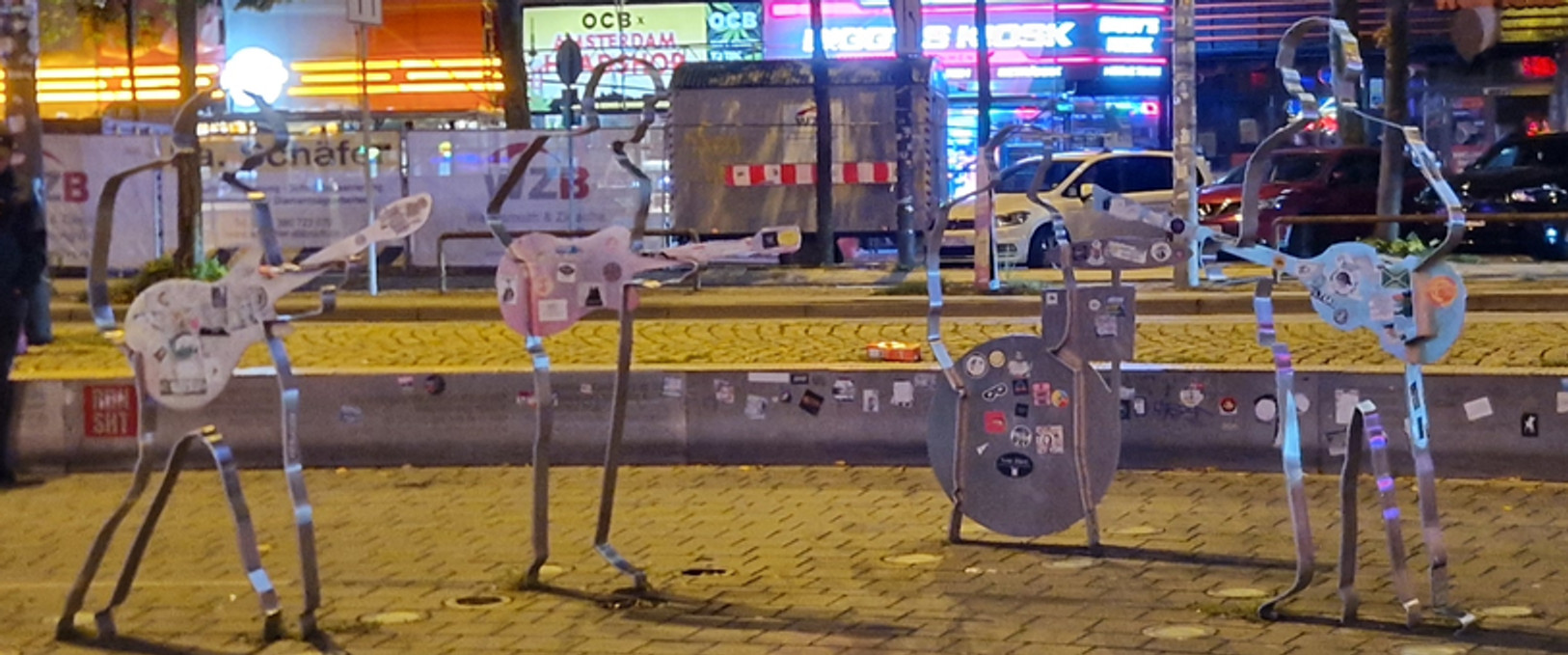
Nearby, Große Freiheit was lit up with neon signs for bars, clubs, dance venues, strip clubs and drag shows. It was quieter down that end, but I guessed the night hadn’t warmed up yet.

Good to know
· The St Pauli Bunker has a lift directly to the top platform if you’d rather not take the stairs.
· HADAG ferries are included with a 24-hour public transport ticket and are an affordable alternative to a dedicated harbour cruise.
· Hamburg has plenty of indoor attractions, so there’s no need to abandon your plans if the weather turns.
· The Elbphilharmonie Plaza is worth considering around sunset, so you can see the city in daylight and after dark.
· Allow time to get around. Hamburg is spread out, and the sights aren’t all clustered in one area.
What would I do differently?
Booked earlier to have more choice of centrally located hotels.
Make extra time to visit U-434.
Allow more time for some of the areas we only explored briefly.
So, How Did Hamburg Score?
Things to Do — 9/10Plenty to keep us busy, from the harbour and historic buildings to the St Pauli Bunker and the absolute wonder that is Miniatur Wunderland.
Getting Around — 9/10Easy enough to get around using trains, walking and even the ferries, which were a great way to see more of the harbour.
Food & Drink — 8/10Plenty of places to stop for a drink or grab something to eat while exploring, although food wasn't really the main highlight of our trip.
Value for Money — 8/10We found plenty to enjoy without spending a fortune, and the ferry was a particularly good way to see more of the city.
Overall Experience — 9/10We really enjoyed Hamburg, with its mix of history, waterfront views and quirky discoveries. We'd happily return, although there's still plenty more of Germany we'd like to explore first.
Would I visit Hamburg again?
Yes, we’d go back one day. Hamburg has a lot to offer, but we’d like to see some other German cities first.
What made me laugh
· Standing opposite the Davidwache police station, a sex worker asked my partner if they needed any help while stroking my partner’s arm.
· Relaxing in the Emirates departures area, avoiding all the chaos going on in our airline’s waiting area.
· Taking the airport train in the wrong direction. I hope this isn’t becoming a regular thing on our trips!
Favourite thing
Walking around the Elbphilharmonie Plaza and realising Hamburg had a lot to offer us, both by day and by night.
“We came to Hamburg for the harbour and Miniatur Wunderland, but it was all the little surprises in between that made the trip.”
